People paid millions of dollars for JPEGs they could have literally screenshot.
You might be thinking why?
Because the NFT bubble was never really about art.
It was about: • scarcity
• FOMO
• celebrity influence
• and speculation disguised as investing
NFT stands for Non-Fungible Token.
It created a system where digital art suddenly became “unique,” even though anyone could still copy or screenshot the image.
The only thing that changed was ownership verification through blockchain.
That single idea triggered a massive speculative frenzy.
People started buying NFTs hoping to flip them at higher prices, and gradually intrinsic value stopped mattering.
FOMO became the valuation model.
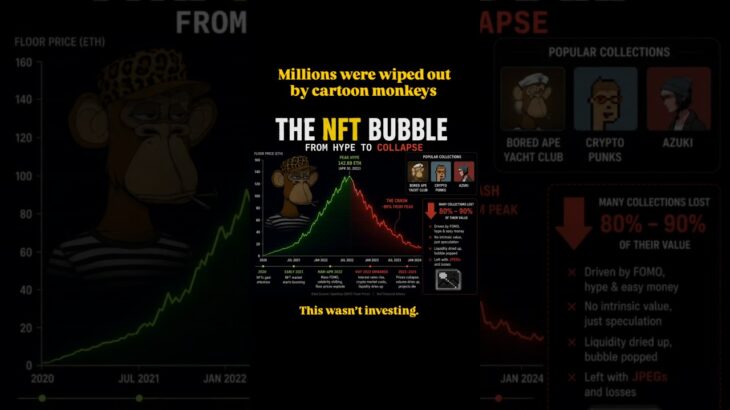
The bubble became even bigger when celebrities and influencers started endorsing collections like: • Bored Ape Yacht Club
• CryptoPunks
• Azuki
Easy liquidity during 2020–2021 also played a major role.
Global interest rates were near zero, crypto markets were booming, and many investors started deploying profits into NFTs as an alternative speculative asset class.
But when central banks shifted toward contractionary monetary policies and interest rates started rising, liquidity began disappearing from financial markets.
Crypto corrected sharply.
And the NFT market collapsed with it.
Many NFT collections eventually lost 80–90% of their value.
One of the biggest lessons from this bubble was this:
When valuation becomes completely disconnected from utility and cash flows, markets can stay irrational for some time — but not forever.
Do you think NFTs still have long-term utility beyond speculation and hype?
Share your thoughts below 👇
#NFT #Crypto #Finance