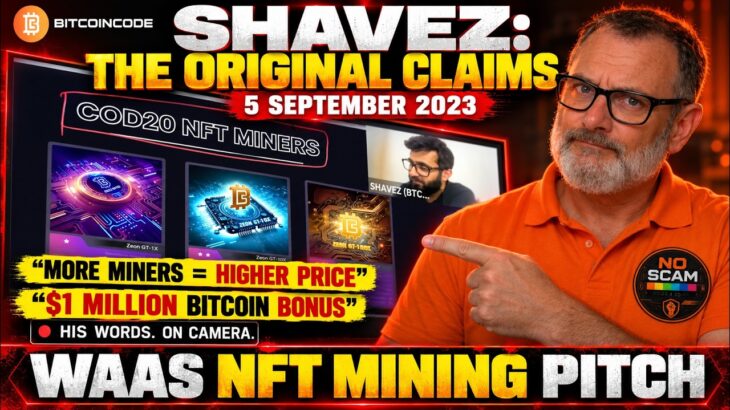
Shavez Ahmed Siddiqui, also known publicly as Shavez Anwar, presents “WAAS Affiliate Marketing Training Sept. 5th 2023.” This original recording preserves the BitcoinCode claims he made to participants — claims now challenged by CryptoG’s blockchain forensic investigation.
Shavez promotes NFT miners, a 140-year mining journey, rewards every ten minutes, BFUEL “electricity” costs, instant cryptocurrency swaps and a supposedly transparent, community-controlled reserve. The underlying code and transaction records tell a substantially different story.
NFT MINING: THE COINS ALREADY EXISTED
Shavez presents ZEON GT 1X, GT 10X and GT 100X NFTs as cryptocurrency miners, with different power ratings and a share of 7,200 BTCC distributed daily.
CryptoG found all 21 million BTCC already held in one creator wallet before the mining contracts were deployed. The examined NFT contracts contained no mining code. A separate reward pool distributed existing coins rather than the NFTs producing new cryptocurrency through Bitcoin-style mining.
BFUEL: TOKEN PAYMENTS PRESENTED AS ELECTRICITY
Shavez describes BFUEL consumption per second, calculates daily “electricity” costs and promises a permanently fixed pricing relationship.
CryptoG found an internal token payment mechanism. Half the BFUEL collected was burned; half went to a receiving address configured as the creator wallet. The examined token contract did not guarantee the advertised price.
A separate September 2024 promotional demonstration showed approximately $84.35 in BFUEL required to collect BTCC displayed as worth around $67 — a collection cost greater than the advertised reward.
“WHEN THERE ARE MORE MINERS, THE PRICE GOES UP”
Shavez explicitly links increasing miner numbers to a higher price.
CryptoG found no contractual mechanism guaranteeing that outcome. More miners sharing a fixed allocation can mean smaller individual rewards. More participants do not automatically create higher prices or buyers willing to pay genuine money.
DECENTRALISATION VERSUS OWNER CONTROL
Shavez promotes “democratic proof of reserve,” shared custody and a proposed nine-member board of trustees.
CryptoG found concentrated administrative powers over critical infrastructure. The creator address held the original BTCC supply and deployed important contracts. The reward pool’s owner replaced its code three times. Those findings challenge the impression of a system controlled by its participants.
SWAPPING TOKENS IS NOT PROOF OF CASHING OUT
Shavez says participants can swap BTCC into wrapped Bitcoin in real time and cash out in Bitcoin.
CryptoG documented 103,111,088 tokens labelled USDT minted on BitcoinCode’s own blockchain, without establishing corresponding genuine Tether backing. An internal token balance or trading price does not prove equivalent value can be withdrawn.
The examined withdrawal bridge burned submitted tokens and recorded destination addresses but did not itself execute external payments. Separate payments may have occurred; verifying them requires external transaction records.
OTHER PROMISES IN THIS RECORDING
• $50, $500 and $5,000 subscriptions.
• Premium status through recruiting one person on each side.
• Five-percent kickbacks and a ten-percent check-match bonus.
• Three-times earning potential, plus a 30% reserve contribution.
• VOSS token allocations supposedly redeemable in Bitcoin when the reserve matures.
• More than 3.3-times rewards through accumulation and holding.
• Repeatable Bitcoin Club bonuses worth $1 million in Bitcoin.
• Reserve maturity after 500 days or Bitcoin reaching $100,000.
• A Chainlink audit supposedly underway, with reports promised on both websites.
• A ready Satoshi wallet, the cheapest swap prices and a planned exchange.
• A forecast of 50,000 miners on launch day.
These are recorded promises requiring evidence of delivery. The investigation does not establish that every forecast, bonus or audit claim was false.
WHAT CRYPTOG ESTABLISHED
CryptoG analysed 285,065 transaction rows involving 30,628 addresses. The findings expose substantial contradictions in the mining story, advertised decentralisation and assumptions about financial backing.
The investigation does not establish that US$103 million was stolen or that Shavez personally controlled the creator wallet. The $103 million figure concerns internally minted USDT-labelled tokens whose backing was not verified.
This video preserves his original pitch. The investigation tests that pitch against the blockchain evidence.
If you participated in WAAS or BitcoinCode, share payment receipts, wallet addresses and withdrawal transaction hashes through:
https://www.dehek.com/contact
READ THE FULL INVESTIGATION: https://www.dehek.com/general/scam-fraud-investigations/shavez-ahmed-siddiqui-exposed-bitcoincodes-fake-nft-mining-and-103-million-usdt-mystery/